

Turbo inlet suitable for BMW B57 engines Gen2 (without LP-EGR)
Turbo inlet suitable for BMW B57 engines Gen2 (without LP-EGR)
 Engineered by engineers - 3D scan - CAD design - technical analysis
 CFD-optimized flow - bionic geometry for efficient air flow
 Designed for efficiency - Fewer flow losses · more usable potential
 PRECISE FIT & PLUG & PLAY - No software adaptation required
- Ready to ship in 2-3 days
Couldn't load pickup availability
Maximum flow efficiency for the BMW B57 without LP-EGR
Our RevDop turbo inlet for the BMW B57 from model year 2020 onwards has been developed to specifically optimize the airflow between the intake system and the turbocharger.
The goal is not simply to make the cross-section as large as possible. The decisive factor is an efficient, controlled, and low-loss guidance of the air to the turbocharger compressor.
By using topology optimization, CAD design, and CFD flow simulations, a bionically optimized internal geometry with harmonious transitions and an optimized flow cross-section was created.
The result is an optimized air path with reduced flow-related losses and more homogeneous flow to the turbocharger.
Benefits at a glance
- Up to 58 Nm and 30 hp more than the OEM inlet
- Bionically flow-optimized internal geometry
- CFD-optimized air path to the turbocharger
-
30% less pressure loss
- 20% more fluid volume
- Optimized usable flow cross-section
- More harmonious flow to the compressor
- More efficient airflow when air demand is increased
- Optimized geometry compared to the OEM inlet
- Direct replacement of the original component
- High-quality manufacturing from PA12
- High temperature resistance
- Oil, fuel, and chemical resistance
- Suitable for stock vehicles and performance-optimized applications
Bionic flow optimization
The characteristic geometry of the RevDop turbo inlet is not accidental.
The development process begins with an analysis of the original component. Based on the existing geometry and defined boundary conditions, a topology optimization is carried out.
This creates an organic structure from which our bionic geometry is derived.
The topology then serves as the basis for the structural design. We transfer the optimized structure into a production-ready CAD geometry and subsequently re-examine it in terms of fluid dynamics.
The result is a component where the shape is not only visually extraordinary but also serves a specific technical purpose.
Optimized air supply for the turbocharger
The turbo inlet is located directly in front of the turbocharger compressor inlet. The geometry of this area therefore influences how the air is fed to the compressor.
Unfavorable transitions, abrupt changes in cross-section, or unnecessary flow disturbances can lead to additional pressure losses and uneven flow.
Our development therefore focuses on harmonious flow guidance with uniform transitions as much as possible.
The priority is not "more air," but rather more efficient airflow with the lowest possible unnecessary pressure loss.
An optimized intake geometry can be particularly interesting for vehicles with software optimization or increased air requirements.
Development using 3D scanning, topology optimization, and CFD
As with our other RevDop intake components, this turbo inlet is based on a clearly defined development process:
3D scan → CAD → topology optimization → bionic design → CFD → further development → production
The developed geometry is not only viewed separately but examined in direct comparison with the OEM component.
This allows us to assess how changes to the internal geometry affect the flow field and pressure loss.
Our products are therefore not created according to the "bigger is better" principle, but based on targeted technical optimization.
High-quality manufacturing from PA12
The turbo inlet is manufactured using an industrial additive manufacturing process from high-quality PA12.
The material is excellently suited for complex technical geometries and enables us to precisely implement the bionic internal structure developed in CAD.
PA12 offers high dimensional stability and is suitable for the thermal and chemical stresses found in the intake tract of modern diesel engines.
Additive manufacturing also allows us to produce complex geometries economically in small batches and to revert directly to the CAD geometry for future optimizations.
Plug-&-Play installation
The RevDop turbo inlet was developed for the existing OEM interfaces of the corresponding BMW B57.
Installation is performed using the standard fastening and connection points.
The original component can be replaced directly with the RevDop turbo inlet.
Depending on the vehicle, access to the turbo inlet may be limited. For some models, the retaining clip on the turbo inlet must be released from below.
For a clean installation, we therefore recommend using a vehicle lift or having the installation performed by a qualified workshop.
Important note regarding low-pressure EGR
For BMW B57 models from model year 2020, there are different versions of the original turbo inlet. Depending on the vehicle, there may or may not be an open connection for the low-pressure EGR system. On some OEM inlets, the connection area exists in the design but is sealed at the factory. As a result, the actual version is not always clearly identifiable from a parts diagram or an external view. The RevDop turbo inlet offered here is designed for the version without an open low-pressure EGR connection. Please check the version of the originally installed turbo inlet before ordering. If in doubt, you can send us a photo of the removed OEM inlet so that we can check the correct variant together.
Suitable for
B57 Diesel – corresponding OEM turbo inlet version without an open low-pressure EGR connection
OEM reference: 13718598279
Scope of delivery
- 1x RevDop BMW B57 turbo inlet
- Version without an open low-pressure EGR connection
Delivery time
Our products are usually ready to ship within 2–3 business days, provided they are in stock.
If an item is unavailable due to high demand or lack of stock, it is produced using the high-quality PA12 3D printing process.
In this case, the delivery time can be up to 3 weeks.
Legal notice
This product does not have an ABE (General Operating Permit), parts certificate, or type approval.
It is not approved for use on public roads within the scope of the German Road Traffic Licensing Regulations (StVZO). It is intended exclusively for motorsport purposes, export vehicles, or use outside of public roads.
Installation of this product may lead to the revocation of the operating permit in accordance with §19 StVZO.
A possible individual approval in accordance with §21 StVZO must be clarified in advance with a testing organization at your own responsibility.
This is not an original part from BMW AG or BMW M GmbH. The mentioned brand and model names are used exclusively for clear product identification.


Das Turbo Inlet passt perfekt, sieht klasse aus und fühlt sich dank des robusten PA12 auch sehr hochwertig an. Besonders beeindruckend finde ich, dass das gesamte Inlet aus einem Stück 3D-gedruckt wird, ohne störende Kanten oder Übergänge. So etwas habe ich bisher bei keinem anderen Hersteller gesehen!
Ursprünglich wurde geprüft, ob das Inlet vom 540d auch bei meinem M440d passt. Da es noch kleine Unterschiede gab, hat Robin extra ein originales BMW-Teil bestellt und das Inlet entsprechend angepasst. Die neue Version wurde mir selbstverständlich ohne Mehrkosten zugeschickt und passt nun perfekt. Hier merkt man, dass Qualität und Kundenzufriedenheit an erster Stelle stehen. Deutsche Ingenieurskunst, wie man sie sich wünscht!
Vielen lieben Dank nochmal, Robin!
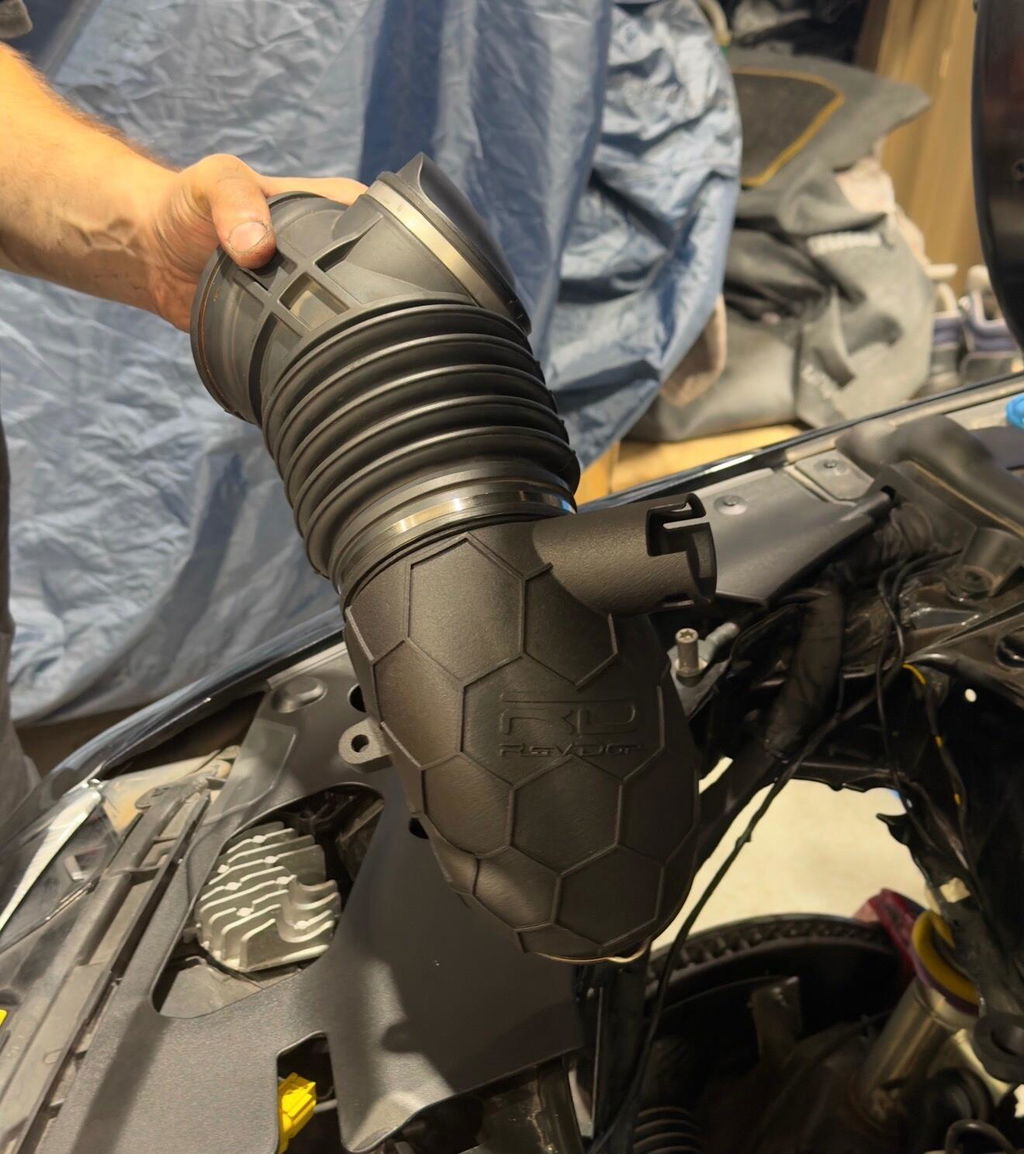
Habe das Inlet für meinen G21 330d Mildhybrid geholt und muss sagen das hat wirklich was gebracht. Ansprechverhalten ist besser und bei der Leistungsmessung kam eine Steigerung von 19nm und 13PS raus. Vorallem jenseitz von 4000u/min bekommt der Lader noch reichlich Luft.
Fahrzeug hat eine Stage 2.